 Download this article in a pdf document –

When organizations evaluate a dealership acquisition, the due diligence checklist is extensive. Buyers scrutinize financial statements, manufacturer financial composites, customer retention metrics, inventory, real estate, employee contracts, litigation exposure, environmental issues, facility image requirements, and blue sky value. Every line item is examined for hidden risk or hidden value.
Yet one of the most overlooked opportunities often receives little or no attention: retail warranty reimbursement. As dealership acquisition activity accelerates across the nation, overlooking this area can mean leaving hundreds of thousands – or even millions – of dollars in future fixed operations revenue unrealized.
Retail warranty reimbursement should no longer be viewed as a routine compliance function. For acquiring dealers, it should become one of the highest-priority operational reviews completed during the first 60 days of ownership.
A Historic Buy-Sell Market Creates New Opportunities
The dealership acquisition market remains remarkably active. According to the latest Haig Report, an estimated 139 dealership rooftops changed hands during the first quarter of 2026, representing a 39% increase over the same period in 2025 and nearly 30% more than pre-pandemic 2019 levels. Even more telling, 96% of acquisitions were completed by private buyers, while multi-dealership transactions increased 54% year over year, illustrating continued confidence in the long-term strength of franchised automotive retail.
Similarly, Kerrigan Advisors reports that dealership buy-sell activity continues to accelerate, with franchise sales increasing substantially during the first quarter as well. Their outlook reflects strong buyer demand, healthy acquisition pipelines, and continued confidence in dealership profitability despite normalization in vehicle margins.
In today’s environment, sophisticated buyers are looking beyond the current income statement. They are asking a different question: “What profit opportunities exist that the previous owner failed to capture?” Retail warranty reimbursement deserves to be one of those questions.
The Factory Reset You Probably Can’t Avoid
Upon an ownership change, the OEM voids the previous dealer’s approved rates. The new owner must submit a new application to have the factory cover warranty work at statutory retail rates, frequently resulting in a temporary drop to the base rate.
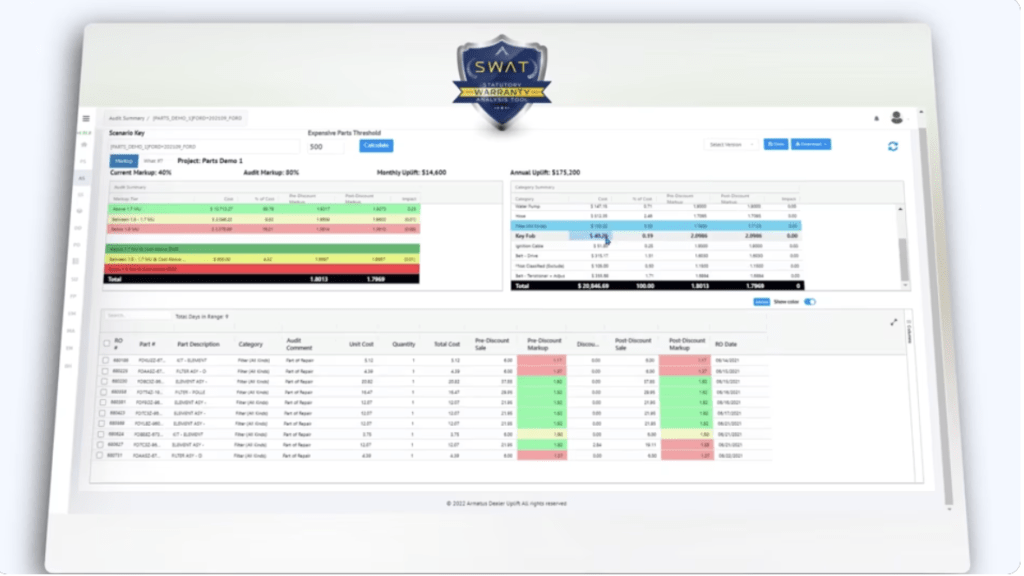
The acquiring dealer must wait until they have enough customer pay (CP) repair orders (ROs) under the new ownership before submitting a warranty rate increase. Accumulating that number of qualifying ROs will typically result in a one-to-three-month delay, depending on the store’s current repair volume. However, those early months are critical in determining a financial projection and whether there’s an opportunity to improve that position prior to a new submission. The Statutory Warranty Analysis Tool (SWAT) from Armatus does just that.
Let’s take a step back and assess the landscape through the eyes of the factory. Typically, most OEM will reset a dealer’s parts markup to 40% or MSRP – far below retail 80%+. Every OEM is different, so the current labor may or may not be retained. Still, in either case, the acquirer doesn’t need to remain in the dark. A complimentary assessment from Armatus can provide clarity. In all likelihood, the warranty reimbursement review will yield a projected increase through the SWAT, even if the previous ownership had been submitted recently. With an experienced team at your side, there’s always an opportunity for more.
Fixed Operations Has Become the Valuation Story
During the pandemic, extraordinary front-end vehicle margins often overshadowed every other department. Today, those margins have normalized. Instead, fixed operations and F&I have become the most stable contributors to dealership earnings. Haig Partners notes that while front-end gross has moderated, fixed operations continues delivering consistent profitability and remains a foundational component of dealership value.
That shift changes how buyers should evaluate acquisitions. Every additional dollar generated through service, parts, warranty reimbursement, and customer retention contributes to sustainable earnings – not temporary market conditions.
Retail warranty reimbursement directly influences that equation. Unlike selling more vehicles or increasing market share, reimbursement improvements often require no additional customers, technicians, service bays, or advertising expense. The work is already being performed. The question is whether the dealership is being properly compensated.
The Opportunity Many Buyers Never Investigate
One reality of dealership operations is that retail warranty reimbursement submissions often receive far less attention than they deserve. Some dealerships submit as soon as state law allows. Others postpone submissions because leadership changes, competing priorities, staffing shortages, or unfamiliarity with reimbursement statutes delay the process. Some stores simply continue operating under reimbursement rates established years earlier, though are typically subject to the OEM rate reset. That creates an opportunity for the acquiring dealer.
Imagine purchasing a dealership that has not updated its warranty labor reimbursement for three or four years despite rising technician wages, higher retail labor rates, and increasing operating costs. The service department may appear profitable. But beneath the surface, every warranty repair may be generating less revenue than state law permits. Once the 100-RO-qualifier allows for submission, it’s unlikely those existing rates are optimized.
Unlike inventory discrepancies or accounting errors, this hidden opportunity rarely appears on a balance sheet. It quietly reduces profitability every single day.
Why the First 60 Days Matter
Most acquisition integration plans focus immediately on culture, staffing, inventory controls, OEM reporting, accounting systems, branding, and operational consistency. Those initiatives are important.
But the first 60 days also represent a unique window to evaluate revenue opportunities inherited from the previous ownership group. A comprehensive warranty reimbursement review should answer several critical questions:
- When was the dealership’s last successful labor reimbursement submission?
- When were parts reimbursement rates last updated?
- When is the dealership projected to be eligible for another submission?
- Have retail labor rates increased significantly since the previous approval?
- Have changes in state statutes created additional reimbursement opportunities?
- Were previous submissions optimized, or simply accepted as adequate?
- Upon an OEM rate reset, would a review of parts and labor rates yield more opportunity?
These questions rarely appear on traditional acquisition checklists. They should. Because unlike many operational improvements that require months or years to influence financial performance, reimbursement optimization can begin generating higher warranty revenue almost immediately after approval.
Hidden Revenue Already Exists
Every acquisition includes assets that are immediately visible:
- customer databases
- technician talent
- parts inventory
- service equipment
- brand recognition
Retail warranty reimbursement represents another asset, except it is often invisible. If reimbursement rates no longer reflect the dealership’s true retail pricing structure, unrealized gross profit already exists within every warranty repair order.
The acquiring dealer doesn’t need to create new demand. The opportunity has already been created through years of performing warranty work under outdated reimbursement levels. The only remaining question is whether someone identifies it. In today’s acquisition environment, where buyers are paying significant premiums for high-performing franchises and placing greater emphasis on predictable fixed operations earnings, overlooking retail warranty reimbursement is becoming increasingly difficult to justify.
For many dealership groups, the first few months following an acquisition determine whether the investment meets or exceeds financial expectations. Integration teams focus on operational consistency, expense management, staffing, customer retention, and manufacturer performance metrics. Every initiative is designed to improve profitability as quickly as possible. And, while a factory reset of parts and labor rates is likely unavoidable, the subsequent submission is critical and requires all current rates to be reviewed, optimized and reflected in at least 100 consecutive ROs. Do not assume the previous owner maximized those rates.
The Revenue Opportunity Already Exists
Unlike many post-acquisition initiatives, optimizing retail warranty reimbursement doesn’t require selling more vehicles, attracting more vehicle owners in for service, hiring additional technicians, expanding the service department, or increasing marketing expenditures.
The work is already being performed. Every warranty repair completed under outdated reimbursement rates represents unrealized revenue that can never be recovered once the repair order is closed.
If the previous ownership group delayed reimbursement submissions – or failed to optimize them entirely – the acquiring dealer inherits not only the dealership’s assets, but also its missed opportunities. That’s why timing matters.
The earlier a reimbursement review identifies opportunities, the sooner the dealership begins operating under reimbursement rates that more accurately reflect its actual retail labor and parts pricing. Those ROs will be used for the new submission. Every month of delay represents revenue permanently left on the table. According to Armatus, the average dealership loses between $8,000 and $12,000 in gross profit for every month reimbursement improvements are delayed.
The Service Absorption Connection
Most acquisition models place significant emphasis on service absorption. For good reason. Strong fixed operations performance provides stability during fluctuations in new vehicle sales, changing interest rates, and shifting consumer demand.
Every improvement in labor recovery contributes to that objective. Retail warranty reimbursement is often one of the few revenue opportunities capable of increasing gross profit without increasing repair order volume.
As reimbursement improves, dealerships strengthen labor recovery, improve effective labor rates, increase warranty profitability, and generate additional resources to reinvest throughout the service department. Over time, these improvements contribute to healthier service absorption and stronger overall dealership performance.
Why Experience Matters
Retail warranty reimbursement has become increasingly technical. Each state has its own statutes governing reimbursement methodologies, submission frequency, documentation requirements, and manufacturer obligations. Individual OEMs maintain unique submission procedures, review processes, and supporting documentation expectations.
A successful submission requires more than simply collecting repair orders. It demands a detailed understanding of state law, statistical analysis, retail pricing methodologies, labor rate calculations, parts markup formulas, and manufacturer review procedures.
That complexity is precisely why many dealership groups choose to work with specialists.
Turning Due Diligence into Revenue
Just as buyers routinely perform reviews of accounting practices, environmental compliance, inventory, receivables, and employee benefits, retail warranty reimbursement deserves a permanent place within every acquisition integration checklist.
A comprehensive review can quickly determine:
- Whether labor reimbursement accurately reflects current retail labor rates.
- Whether parts reimbursement remains competitive with actual retail pricing.
- Whether previous submissions complied with current state statutes.
- Whether the dealership has become eligible for a new submission.
- Whether delayed submissions have created immediate revenue opportunities.
These questions should be answered before months – or years – pass under new ownership.
A Strategic Partner During Integration
This is where a specialized partner like Armatus provides significant value. Rather than treating retail warranty reimbursement as a periodic administrative exercise, Armatus can help dealership groups evaluate existing reimbursement performance immediately following an acquisition, identify unrealized opportunities, and navigate the submission process efficiently.
Through proprietary technology, established methodologies, and extensive experience across all applicable state statutes and manufacturer requirements, Armatus helps dealerships pursue reimbursement rates that better reflect today’s operating realities.
For acquisition teams responsible for delivering post-closing financial improvements, that expertise can accelerate revenue realization while allowing dealership leadership to remain focused on integrating employees, customers, and operations.
Looking Beyond the Purchase Price
The best acquisition teams understand that the purchase agreement marks the beginning – not the end – of value creation.
Two dealerships with identical purchase prices can produce dramatically different long-term returns depending on how effectively the new ownership group uncovers hidden opportunities. Retail warranty reimbursement is one of those opportunities.
Unlike many strategic initiatives that require years to mature, reimbursement optimization can begin generating measurable financial returns relatively quickly after implementation. In an acquisition environment where buyers are paying premium valuations for quality franchises, every source of sustainable earnings deserves careful attention.
The New Best Practice
As dealership buy-sell activity continues and fixed operations assumes an even greater role in dealership profitability, retail warranty reimbursement should no longer remain an overlooked administrative function.
It should become a post-acquisition best practice. The most successful dealership groups will be those that recognize every warranty repair represents not only an obligation to the customer, but also an opportunity to ensure the dealership is fairly compensated for the work it performs.
Conducting a retail warranty reimbursement review within the first 60 days of acquiring a dealership is more than a financial exercise – it is a strategic investment in the long-term profitability of the business. The acquisition may be complete, but the opportunity has only just begun.
For dealership groups committed to maximizing the value of every acquisition, the question is no longer whether a retail warranty reimbursement review should be performed. The question is how much unrealized revenue remains undiscovered until it is.
Let Armatus Perform Your Review
If you’ve just completed a recent dealership acquisition, congratulations! Now, it’s time to unlock hidden revenue from your new asset. Armatus offers a FREE Retail Warranty Reimbursement Review to determine whether unrealized labor and parts reimbursement opportunities are available. In just a few days – and with only a few key pieces of dealership data – our team can identify potential revenue left behind by previous ownership. There’s no obligation, only the opportunity to uncover additional profit and ensure your new dealership is positioned to maximize every warranty dollar it has earned. To get in contact with a warranty reimbursement specialist from Armatus, simply email [email protected] or call (888) 828-0212.

Author Bio: Jordan Jankowski is the Chief Operating Officer at Armatus Dealer Uplift. He has played a key role in consulting on 25 warranty reimbursement laws across the country and is widely considered a subject matter expert in this highly technical arena. Jordan manages a team of over 70 people, who produces thousands of retail warranty reimbursement submissions each year.